

Knoll Ludwig Mies Van Der Rohe - Barcelona® Relaxed Stool
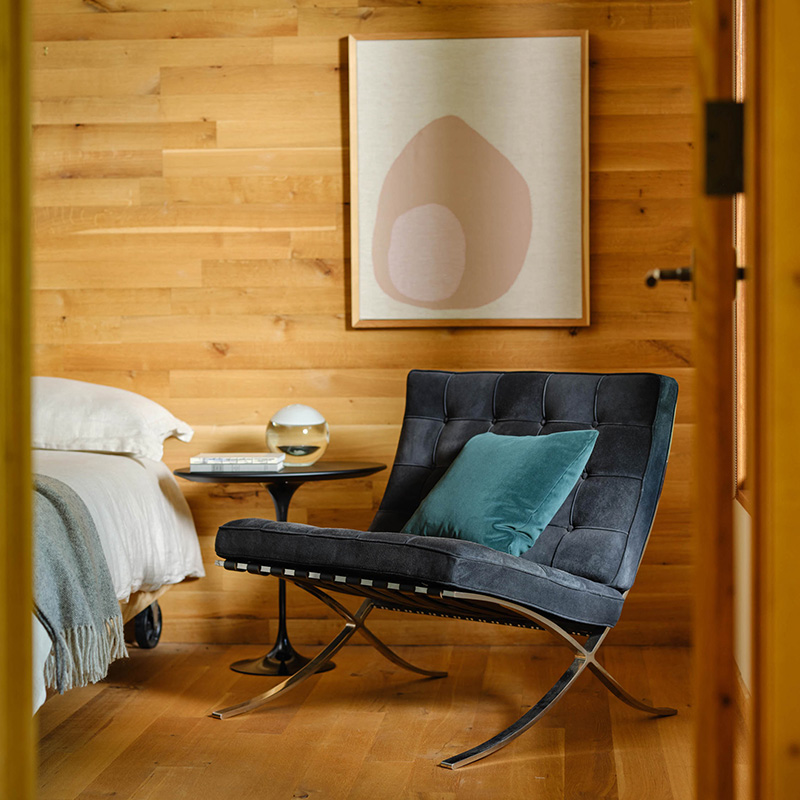
Whether paired with Barcelona Chair or standing alone, the Barcelona Stool exudes a simple elegance that epitomizes Mies van der Rohe's most famous maxim–“less is more.” Each Barcelona piece is a tribute to the marriage of modern design and exceptional craftsmanship.
A carefully studied "relaxed" cushion design brings greater comfort and a more residential feel to what remains the undisputed "monument" of design history. The Barcelona Relaxed Chair, Stool and Couch offer a more supple and relaxed exterior appearance and a softer seat.
MEASUREMENTS:
- Height: 37.3 cm / 14.7 inch
- Width: 63.5 cm / 25 inch
- Depth: 58.9 cm / 23.2 inch
MATERIALS:
- Frame is polished chrome hand-ground and hand-buffed to a mirror finish. Upholstery straps attached with aluminum rivets
- Cushions are premium quality, highly resilient urethane foam with down-like dacron polyester fiberfill
HELPFUL NOTES:
- Upholstery straps are cowhide belting leather. Sides are dyed to match specified upholstery color
- Cushion has 18 Individual panels cut, hand-welted, and hand-tufted with leather buttons produced from a single cowhide.
- Stainless Steel: Completely rust-proof, highly durable, and resistant to bending stress. Light scratching blends with time.
- Polished Chrome: Several-step plating process that includes a heavy layer of nickel for added rust protection and a bright mirror finish.
- The KnollStudio logo and signature of Ludwig Mies van der Rohe are stamped into the leg
- Greenguard Indoor Air Quality Certified®
Many Knoll products are subject to shipping charges. Please check our shipping policies for details.

Ludwig Mies van der Rohe
Germany, 1886 - 1969
Mies van der Rohe began his career in architecture in Berlin, working as an architect first in the studio of Bruno Paul and then, like Le Corbusier and Walter Gropius, for Peter Behrens. In 1928, Mies and his companion and colleague, the designer and Bauhaus alumna Lilly Reich, were asked to design the German Pavilion for the 1929 International Exposition in Barcelona. The purpose of the Pavilion was to provide a location that could be visited by the king and queen of Spain during the opening of the Exposition. With that in mind, Mies designed a modern throne – known today as the Barcelona Chair – for their majesties. In the following year, Mies designed another notable chair, the Brno, with a gravity-defying cantilevered base.
In 1930, Mies succeeded Walter Gropius as the director of the Bauhaus, where he stayed until the school closed in 1933. In 1937, Mies emigrated to the United States, and a year later became the director of architecture at the Illinois Institute of Technology. The rest of his career was devoted to promoting the modernist style of architecture in the U.S., resulting in rigorously modern buildings such as the Farnsworth House and the Seagram Building, designed with Philip Johnson.
The modern city, with its towers of glass and steel, can be at least in part attributed to the influence of architect Ludwig Mies van der Rohe. Equally significant, if smaller in scale, is Mies’ daring furniture designs, pieces that exhibit an unerring sense of proportion, as well as minimalist forms and exquisitely refined details.

Boasting an extensive portfolio of products ranging from office work systems and residential mid-century modern classics, to textiles and accessories, Knoll is a leader of modern and sustainable design. Iconic designs from classic designers such as Harry Bertoia, Eero Saarinen, Warren Platner, Isamu Noguchi and Florence Knoll herself make up a large component of Knoll's collection, along with innovative contemporary pieces. Knoll's products can be found in private residences and major art museums alike, including 40 products in the permanent collection of the Museum of Modern Art in New York.
Founded in 1938, Knoll's reputation for design integrity has a long and decorated history under the guiding principle: "good design is good business." Knoll invests in extensive research, field studies, customer collaborations, and partners with experts from the fields of architecture, organizational behavior, technology and business management to ensure that its products adapt and respond to the evolving needs of their customers. Environmental needs and requirements are not overlooked by the design house either. In fact, Knoll is also considered a leader in production practices that reduce waste, conserve natural resources and protect the biosphere.
Knoll has a strong international presence in the design world - headquartered in Pennsylvania, USA with showrooms across North America, Europe and represented by dealers throughout Latin America and Asia.
Knoll products incur a 7.5% shipping charge at checkout, with a minimum of $85 and maximum of $500. This fee reflects White Glove Delivery for large items, which includes bringing the item to your room of choice, unpacking, removal of packaging, and assembly.
For further information on our shipping policies click here.
For further information on returns + refunds click here.


